


What You Don’t See in the Cake Photo

The work behind the details—and what it means for your cake budget.

A floral cake from The Cake Studio FoCo portfolio.
A cake photo can make you stop because of one detail: a flower, a textured finish, a beautifully shaped tier. You save it because you love how it looks.
When it comes to planning your own cake, that detail is a useful place to start. It can also be one of the things that changes the amount of work involved.
I’ve been thinking about this after a recent Online Restaurant Academy lesson on food costs. I graduated from culinary school in 2008, where we spent an entire course on the subject. It was part of my work as a chef at Restaurant 415, too. Now, as a cake artist and business owner, I’m looking at those familiar numbers alongside the work you see in my portfolio.
Start with the part you love
Two cakes can be similar in size and involve very different work.
A simple finish and a short message are one direction. A design with intricate piping, handmade decorations or sculptural elements involves additional materials and techniques. Making the cake smaller doesn’t necessarily make those details quick to create.
That matters when you’re comparing inspiration photos. Tell me which part made you save one. Is it the overall shape, the color, the flowers or the texture?
Knowing that helps focus the conversation about the design and budget.
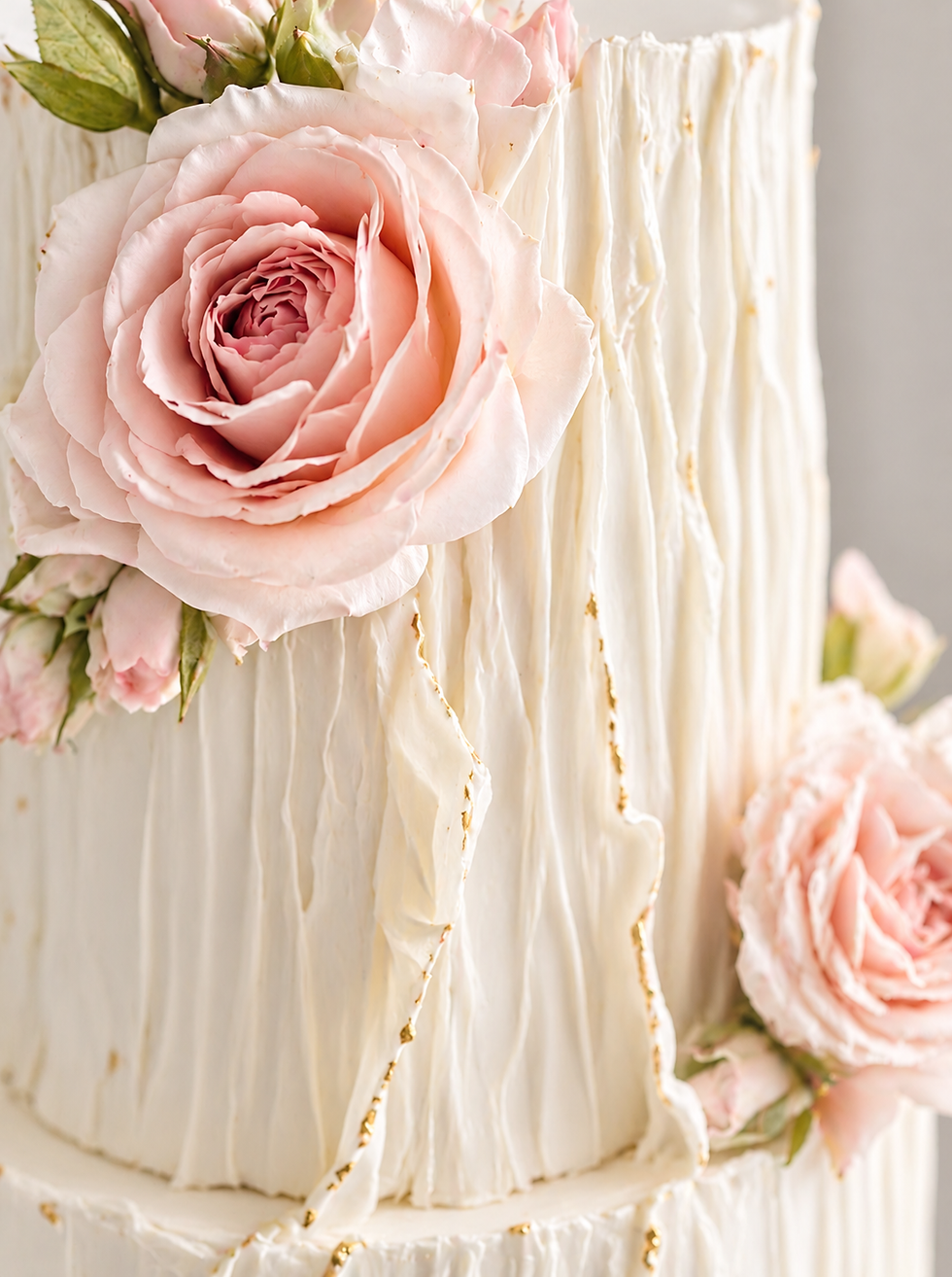
Floral detail and textured finish from the studio portfolio.
Before it reaches the table
There’s the cake itself, of course. Depending on the recipe, ingredients might include flour, sugar, eggs, butter, chocolate, fruit or vanilla. Fillings, syrups, buttercream and edible decorations each have ingredients to account for.
Then there’s the work: planning the design, organizing supplies, weighing and mixing, making the separate components, filling, assembling, decorating and packaging. Cleaning up belongs in the working day, too.
At The Cake Studio FoCo, I personally design and create each cake. The finished piece carries all of that work with it.
A useful way to understand the price is to look at the different costs underneath it:
Part of the price | What it covers |
Ingredients | The quantities used in the cake, filling, finish and edible details |
Labor | Time spent planning, preparing, making, decorating and packing |
Packaging and supports | The board, box, labels and structural materials required |
Shared business costs | A portion of business-use utilities, equipment upkeep and operating expenses |
Payment processing | Applicable transaction fees |
Planned profit | The amount intended to remain after costs are covered |
For a cottage food business, operating expenses can include a website, software, bookkeeping, insurance, training and marketing. Those costs still need a place in the calculation.
The person making it belongs in the price
This is the part I keep coming back to.
A cake can sell and cover its ingredients while leaving very little for the person who made it. That’s why paying for the work and earning a business profit need to be considered separately.
My concern is how easily a maker’s own time can be left out. Including it gives a clearer picture of what the cake takes to produce.
Bring your budget and your favorite detail
You can use this information when you’re planning:
Start with servings. A cake for a cutting moment is a different order from one serving the whole reception.
Choose your priority. Identify the detail you care about most, then discuss the finish and decoration around it.
Compare complete quotes. Look at the size, included details, collection or delivery arrangements and final total.
My pricing guide explains the available cake formats and starting prices. Delivery and setup are quoted separately when needed, and applicable tax is shown separately on the invoice.
Send your date, number of cake servings, budget and design ideas. Include your pickup or delivery plans—and the photo that caught your eye.


